
- Business, Finance
The Mental Side of Entrepreneurship: How CPG Founders Can Stay Strong Without Burning Out
By:

Sponsored by Run the Numbers Consulting
Run the Numbers Consulting partners with CPG brands to strengthen operations, sales, and data through fractional leadership and data-driven insights. Their consultants work alongside brand teams across sales, operations, data analytics, finance, and deductions.
Five years into running TeaSquares, I had my first panic attack. After a particularly brutal stretch, I came home one day, couldn’t catch my breath, and ended up on the kitchen floor. My wife recognized what was happening and helped me through it. That moment made one thing clear: something had to change.
Like most founders, I had started with energy, conviction, and a belief that if I kept pushing, I could outwork the next problem. There was always something demanding attention: production, sales, packaging, cash flow, retailer conversations, inventory, fundraising. The question underneath all of it was whether we were moving fast enough.
Lisa Thorson, founder of Run the Numbers Consulting, puts it plainly: “So many founders are sprinting toward a finish line that keeps moving. They never stop to recoup what they’ve spent: their energy, their health, their peace of mind.”
For a while, that pressure can be energizing. You learn fast, solve problems creatively, and build a real tolerance for uncertainty. But the same mindset that gets a company off the ground can quietly start working against you.
“Just push through” becomes the default response to every problem. You take fewer breaks. You stop marking wins. You make decisions from urgency rather than clarity, which tends to create more problems, which keeps you busier than ever. And because the business depends so heavily on you, slowing down starts to feel irresponsible, even when your body is telling you something different.
Burnout Is Not a Badge of Honor
There is a particular kind of pride that runs through founder culture around overwork. You hear it in peer groups and on LinkedIn: “I’ve been heads-down for months.” “I haven’t taken a weekend off in a year.” It gets offered as evidence of commitment. Lisa has seen enough founders reach their limit to know it’s something else entirely.
“Burnout is not proof that you’re working hard,” she says. “It’s proof that you need to manage your business differently.” It’s a signal that the way you’re carrying the business has stopped working.
There are seasons where extreme effort is simply part of the job. Early-stage brands are messy. You will stretch, improvise, and do things that are nowhere near your job description. That’s real, and it’s worth acknowledging.
But there is a difference between a hard season and a permanently unsustainable operating mode.
Burnout rarely shows up all at once. It arrives gradually. Decisions start feeling harder than they should. Small problems trigger outsized reactions. You procrastinate on tasks you used to handle without thinking. You feel guilty when you rest and resentful when you work. The excitement about the business fades even though you still care deeply about it.
For many founders, the hardest part is that burnout can feel like personal failure. The internal voice says: “I chose this. I started this company. I should be able to handle it.” But burnout is usually not a character flaw. It’s a structural problem, a sign that the business has outgrown the way you’ve been sustaining it.
Why CPG Founders Are Especially Vulnerable
Every entrepreneur deals with pressure, but CPG has its own particular texture of stress.
You are building a physical product, which means your mistakes are often expensive and visible. Demand spikes require cash to produce inventory. Demand slows and you may be sitting on product that ties up working capital. If packaging changes, ingredient costs rise, freight gets more expensive, or a retailer delays payment, the impact ripples through the whole business quickly.
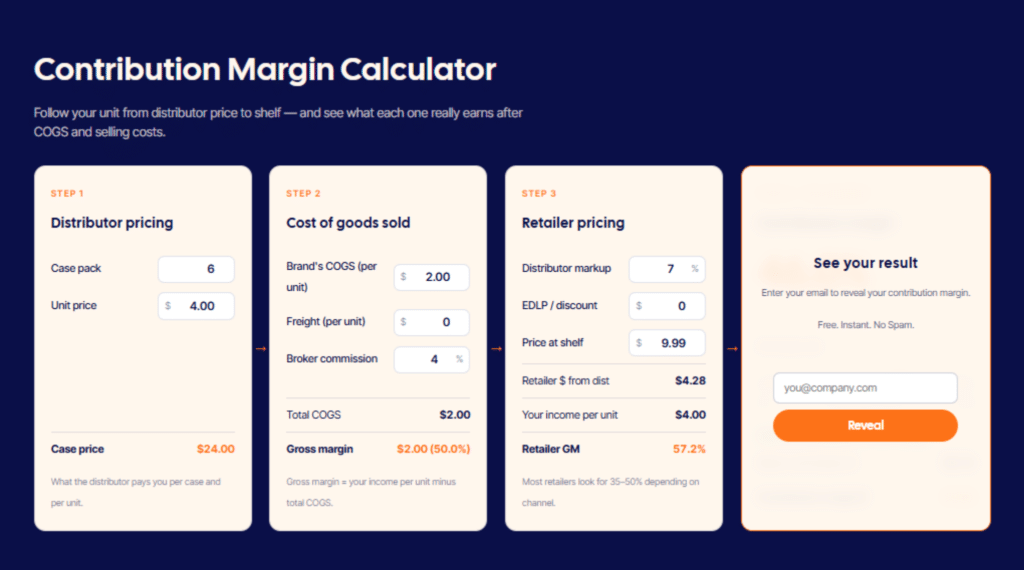
Then there is the margin math. Getting into retail can feel like a breakthrough, and it often is, but once you account for distributor margins, retailer margins, promotions, free fills, deductions, brokers, and freight, the economics tighten in ways that catch founders off guard.
On top of the mechanics, there is the emotional weight. This is your recipe, your story, your mission, your community, and often your personal savings on the line. When a buyer says no, it can land as a personal rejection. When sales are slow, it can feel like the market is telling you something about your judgment.
That is why founder resilience is not just a wellness topic. It is a business strategy. Your mental state directly shapes how you negotiate, how you lead, how you price, how you hire, and how you respond when things go wrong.
Staying Strong Without Burning Out
The goal is not to eliminate stress. Building a brand will always involve uncertainty, risk, and decisions you do not feel fully prepared to make. The goal is to build enough clarity, support, and recovery into your rhythm so that stress is not the only fuel the company runs on.
Start by separating urgent from important. In CPG, almost everything can feel urgent. A retailer needs a form. A production partner needs an answer. A customer has a complaint. Your inbox fills up and suddenly your day is run entirely by whoever reached you most recently.
Urgent work demands a response. Important work moves the business forward. Reviewing margins, improving your sales strategy, building a cash flow forecast, refining your product line, deciding which channels are actually worth pursuing: these things rarely feel urgent, but they are what determine whether the business is healthy six months from now. If you only respond to urgency, you can stay perpetually busy while the business stays fragile.
It also helps to create a regular decision rhythm. A lot of founder stress lives in open loops: Can we afford the next production run? Should we say yes to this retailer? Is this channel actually profitable? Are we overspending on trade? When these questions never have a dedicated time and place to be addressed, they follow you everywhere: into dinner, into weekends, into the moments you actually need to recover.
Setting aside time each week to review sales, cash, inventory, and upcoming commitments does not solve everything at once. But it creates a container for those questions so they are not constantly leaking into the rest of your life.
Lisa is direct about the other piece: “You have to step away and do something that actually refuels you: food, a walk, a nap, time with someone you love. Even a short break makes you more useful when you come back. It’s not a luxury. It’s maintenance.”
The Financial Side of Founder Stress
One of the biggest sources of burnout is financial uncertainty. After we raised our first $100,000 investment, I felt like we had finally caught a break. Within a few months, I was watching the bank account drop every month and wondering how long we could sustain it.
It is hard to feel steady when you do not know how much cash you will have in eight weeks. It is hard to make confident calls when you are unsure whether a retailer is actually profitable. It is hard to sleep when you are carrying questions about inventory, margins, deductions, payroll, and production costs entirely in your head.
This is where financial clarity becomes part of mental resilience, not as a luxury, but as a direct input to how well you function.
Lisa started Run the Numbers Consulting because she kept seeing the same pattern: founders making emotional decisions in the absence of clear numbers, and then spending enormous energy managing the consequences. “There’s a real calm that comes from knowing your numbers,” she says. “It’s not as exciting as winning a big retailer account. But knowing what you can and can’t afford keeps the story you tell yourself grounded in something real.”
Clear numbers do not remove the hard decisions. You may still need to manage cash carefully, say no to certain opportunities, or rethink parts of your growth plan. But clarity reduces the weight of what you are carrying.
When you understand your margins, you can price with more confidence. When you understand cash flow, you can plan production more thoughtfully. When you understand channel profitability, you can decide which opportunities are worth pursuing and which ones are generating more stress than value.
A lot of founder anxiety is vague. “Something feels off.” “I don’t know if this is working.” “We’re growing, but I’m not sure we’re actually making money.” The more specific your numbers become, the more specific your decisions can become. That specificity is worth a great deal.
Build a Company That Does Not Depend on Your Exhaustion
Many founders accidentally build companies that require their constant presence. Every decision runs through them. Every customer issue escalates to them. Every number lives in their head. Every process depends on their memory.
That may hold together at the beginning. It becomes dangerous as the business grows.
A more sustainable company requires systems that reduce founder dependency: documented processes, clear team ownership, regular financial reporting, better inventory planning, decision frameworks that allow the team to operate without waiting for approval on everything. Building those systems has a cost, and that cost is worth factoring into your budget and your margin assumptions from early on.
It also means being honest about what the business model demands. Some brands are exhausting because they are undercapitalized. Others are exhausting because the margins were never quite right. Some are chasing too many channels too early. Others are saying yes to revenue that creates complexity without enough profit to justify it.
Founder wellness cannot be fully separated from business design. If the company only functions when you are overextended, the model needs attention.
Final Thought
Resilience is not the ability to endure indefinitely. It is building enough clarity, support, and recovery into how you work so that you can keep making strong decisions without running yourself into the ground.
As Lisa puts it: “Give yourself permission to stop and refuel: with rest, a walk, a meal, your family, music, something that brings you back to yourself. That’s not time away from the business. That’s how you stay able to run it.”
For many CPG founders, financial uncertainty is one of the heaviest things they carry. Run the Numbers Consulting helps founders get clear on their margins, cash flow, and channel profitability so they can lead with more confidence and less guesswork.
If you’d like an introduction to Run the Numbers Consulting, reach out at lisa@runthenumbersconsulting.com.
Education Articles