
- Finance
3 Reasons Not to Use PO Financing
By:
Sponsored by: Bridge is the official financing partner for Walmart and Sam’s Club suppliers. Bridge offers purchase order financing that funds your production costs at rates competitive with traditional inventory and asset-based loans, without taking a loan against your business.
Keep your cash free for running and growing your business. Request financing at bridgemarketplace.com.
Purchase order financing can be a powerful tool for CPG brands. It can help bridge the gap between receiving a retail order and finding the cash to produce and fulfill it. For the right business, at the right moment, it can create room to grow without forcing the company to choke its own operations.
But that does not mean every brand should use it.
In fact, one of the biggest mistakes founders make is treating financing as a default solution instead of a strategic one. The better question is not “Can I get PO financing?” The better question is “When should I use PO Financing?”
There are real moments when the answer is no.
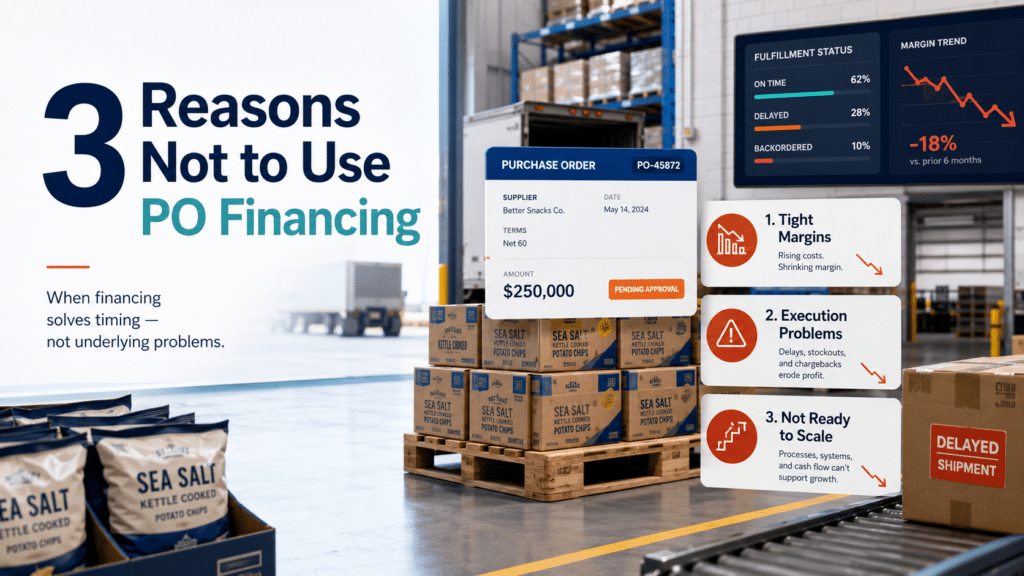
Here are three reasons not to use PO financing.
1. Your Margins Are Already Too Tight
PO financing solves a timing problem, not a margin problem.
That distinction matters. If your product economics are already thin, adding financing costs on top can make the order much less attractive than it looks on paper. A big retail PO can feel like a win, but if the brand is barely making money after cost of goods, freight, trade spend, and retailer deductions, financing may just compress margins further.
Founders sometimes assume that a larger order will automatically improve everything through scale. Sometimes it does help. But scale can also expose fragile economics. Increased volume may come with more operational complexity, higher support costs, and more deductions than expected. If the deal only works in the most optimistic version of the spreadsheet, that is a warning sign.
Before using PO financing, a founder should be clear on the true contribution margin of the order. Not just product cost. Not just invoice value. The real margin after all the costs required to produce, deliver, and support that business.
If the numbers are already too tight without financing, then financing is not fixing the problem. It is just helping the brand lose money faster.
2. You Are Using It To Cover Execution Problems, Not Growth
PO financing works best when there is a credible business behind the order. You have demand. You have operational capacity. You understand the requirements. You simply need working capital to bridge the timing between spending and payment.
That is very different from using financing to patch over deeper problems.
If your production process is unstable, your co-man is unreliable, your forecasting is weak, or your team does not have a clear fulfillment plan, outside capital may not reduce risk. It may increase it. More money does not automatically create better operations. In some cases, it just gives a struggling system more volume to mishandle.
This is especially true when founders are still trying to prove basic repeatability. If you do not yet know whether you can deliver on time consistently, or whether your supply chain can hold up under pressure, financing may create obligations before your business is truly ready for them.
Capital should support execution, not substitute for it.
One of the healthiest signs that PO financing could make sense is that the business already knows how to fulfill successfully and just needs more flexibility to handle a larger-than-usual order. If that foundation is missing, the financing itself can become another source of pressure.
3. Your Operations Aren’t Ready To Fulfill At Scale
PO financing does not fix operational readiness.
It gives you the cash to produce and deliver a larger order, but it assumes your systems can actually handle that volume. If your operations are not ready, financing will amplify the problem.
This is where brands get into trouble. A larger PO means more production runs, tighter timelines, higher freight coordination, stricter retailer requirements, and more room for costly mistakes. If your co-man struggles with consistency, your logistics are not dialed in, or your team does not have a clear fulfillment plan, adding capital will not stabilize things. It will increase the pressure.
Retailers do not give you extra leeway because you are growing. They expect on-time, in-full delivery. Missed ship windows, chargebacks, or quality issues can damage the relationship quickly.
Before using PO financing, you should be confident that your operations can execute at the next level. Not just in theory, but in practice. You have already fulfilled similar orders successfully. You understand your lead times. Your supply chain holds up under pressure.
If that foundation is not in place, financing does not create readiness. It just accelerates risk.
So When Does Po Financing Make Sense?
It can make sense when your margins are healthy enough to absorb the cost, your operations are ready to fulfill at the required level, and the main challenge is timing. In that case, PO financing can help a brand confidently take on more doors, larger orders, or expanded SKU counts without draining internal cash.
Used well, it can support growth.
If you’re ready for PO Financing I recommend working with Bridge.
Bridge helps growing CPG brands secure flexible PO financing so they can cover production and fulfillment costs tied to large retail orders without draining the rest of the business. When a brand gets a bigger Walmart order, expands into more doors, or adds more SKUs, Bridge can help founders manage the cash flow gap between shipping products and getting paid.
Bridge is a direct lender that funds up to 100% of your production costs on approved Walmart and Sam’s Club orders. Share your PO, get terms fast, and keep your cash free for growth.
Want an introduction? Click the button below to ask for an intro and get connected.
Education Articles