
- Business, Operations
How to Cut Costs Without Touching Your Recipe
By:
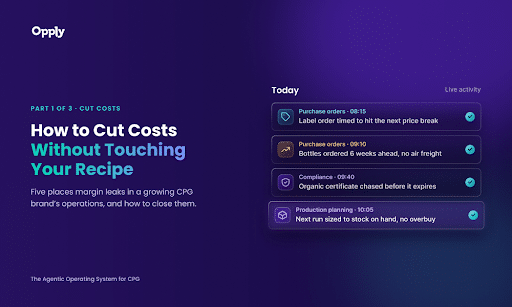
Sponsored by Opply, the agentic operating system for CPG: AI that runs your operations end to end, so your team can spend its time growing the brand.
When margin gets tight, most brands reach for the same two levers: reformulate or raise prices. Both put the product at risk. One changes what your customer tastes. The other changes what they pay.
There is a third place to look, and it is usually the largest. A growing brand loses margin in how it buys: prices nobody has checked in a year, orders sized to a supplier’s minimum, freight booked in a panic, and hours spent chasing confirmations. None of it appears on the ingredient deck. All of it lands in the cost of goods.
This article covers five places to look, with a one-page review you can run this quarter.
Where does margin leak in a growing CPG brand?
In five places: supplier prices that have never been benchmarked, order quantities set by minimums instead of demand, rush costs caused by late information, team hours spent on order admin, and cash paid out long before customers pay. Each one is small on its own. Together they can decide whether a new listing makes money.
Do you have the right suppliers, or the ones you started with?
Most brands inherit their first suppliers from whoever developed the recipe, or from the co-manufacturer’s own list. Those suppliers were right for a first run of a few thousand units. They are rarely re-tested as volumes double.
The problem is seldom effort. Founders do negotiate. They negotiate without data on what comparable brands pay, and with volumes too small to move a supplier. So start by building the data.
List your top five inputs by annual spend. For each, get two comparable quotes on the same spec and compare the landed cost: unit price, freight, minimum order quantity, lead time, and payment terms. Then weigh reliability. A supplier that is 4% cheaper and delivers late twice a year can cost more than it saves.
The aim is the right supplier for where the brand is going. Sometimes that is your current one, on better terms because you now have a benchmark.
How much should you buy at once?
A lower unit price does not make a larger order the better purchase.
Take an illustrative example. A snack brand buys six months of printed film instead of two to earn an 8% discount. The order costs $30,000 and the discount is worth about $2,600. In month four the brand updates its artwork for a new retailer and scraps the last third of the film. That is $10,000 written off to save $2,600.
Compare options on the full commitment: price, freight, storage, expected usage, shelf life, and the risk of a change. Ask suppliers for staggered deliveries against an agreed annual volume, and confirm when payment falls due. A split delivery does nothing for cash if the whole order is invoiced upfront.
What do operational surprises really cost?
Expedited freight, emergency spot buys, and a lost slot at the co-manufacturer all look like bad luck. Most trace back to information that arrived late: an order nobody confirmed, a lead time that had quietly grown from three weeks to six, a certificate that expired the week of the run.
Three habits remove most of them. Get every purchase order confirmed in writing within two working days, with a dispatch date. Record each supplier’s actual lead time next to the one it quotes, and plan on the actual. Set a reorder point for every critical input, with a named owner.
Then put a number on it. Add up last year’s expedite fees, spot-buy premiums, and re-booked production. That total is the budget for fixing the cause.
What does order admin cost you each year?
Order admin rarely gets counted as a cost, because nobody invoices for it. Count it anyway. Ten hours a week spent placing and chasing orders, at a loaded cost of $50 an hour, is $26,000 a year. In a founder-led brand those are usually the founder’s hours, taken from selling. It is also work that AI can now take on, provided it can act and not only advise.
When does cash timing become a cost?
Suppliers often want payment upfront or within 30 days. Retailers and distributors commonly pay in 60 days or more. That gap has a price even when no interest is charged: card fees to stretch a payment, early-payment discounts you cannot take, and smaller runs at a higher unit cost because cash is tied up in the last one.
Build a rolling 13-week cash calendar with supplier deposits, production balances, freight, and expected customer receipts, and update it weekly. Look at the lowest week, because that week decides what you can order. Then ask for terms where your order history supports it.
A one-page cost review for this quarter
- Top five inputs: current price, date of the last benchmark, and two comparable quotes.
- Minimums: every input where you hold more than three months of cover, and what it would cost to split the order.
- Surprises: last year’s expedite fees, spot buys, and re-booked runs, with the cause of each.
- Admin: hours a week spent placing and chasing orders, multiplied by loaded hourly cost.
- Cash: the lowest week in your 13-week calendar, and the supplier payment that causes it.
Rank the five by dollars and start with the largest.
How Opply cuts costs across the whole operation
Every line in that review is work, and it competes with selling. A general-purpose AI assistant can draft the supplier email or build the spreadsheet, and the work is still yours to do. Opply is AI that does the work. As the agentic operating system for CPG, it runs your operations end to end with the suppliers you already use, and finds new ones where you need them.
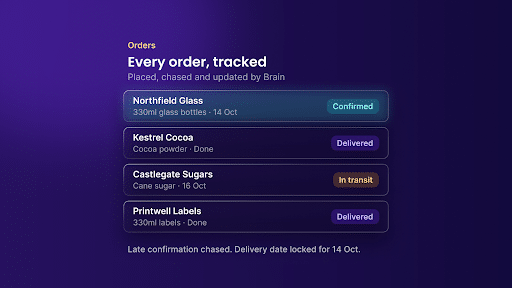
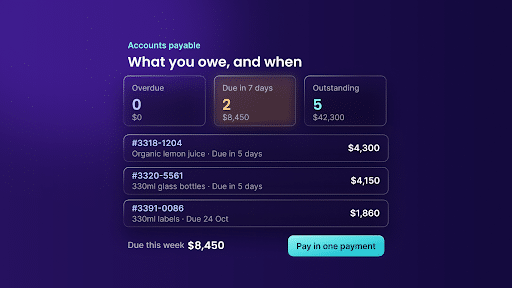
Opply, places, confirms, and chases every purchase order. It finds and qualifies suppliers and co-manufacturers against your spec, tracks how each supplier delivers on the orders it runs, and keeps certificates current. It pays your suppliers on their terms, with up to 90 days to pay for eligible brands, and shows everything you owe in one view.
A general-purpose AI knows what you tell it and what is public. Opply learns from every order across its network of brands and thousands of qualified suppliers, so it knows the going rate for an ingredient and which suppliers deliver on time. That is pricing data and buying power a growing brand could not build alone.
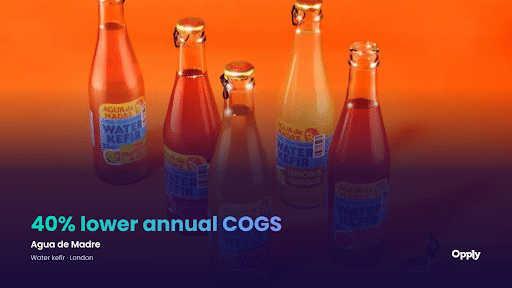
The results show the cost of goods. Agua de Madre cut its annual COGS by 40%, with a 14X return on investment. Counter Culture cut annual COGS by 35%, and Unrooted by 40%. “Opply, have transformed this side of our business,” says Leon Pullin, Managing Director of Agua de Madre.
Cutting costs is one of three ways Opply grows profit for CPG brands, alongside protecting revenue and expanding the business.
See what Opply would run for your brand. Book a 30-minute demo built around your own suppliers and orders at opply.com.
Education Articles