
- Resources
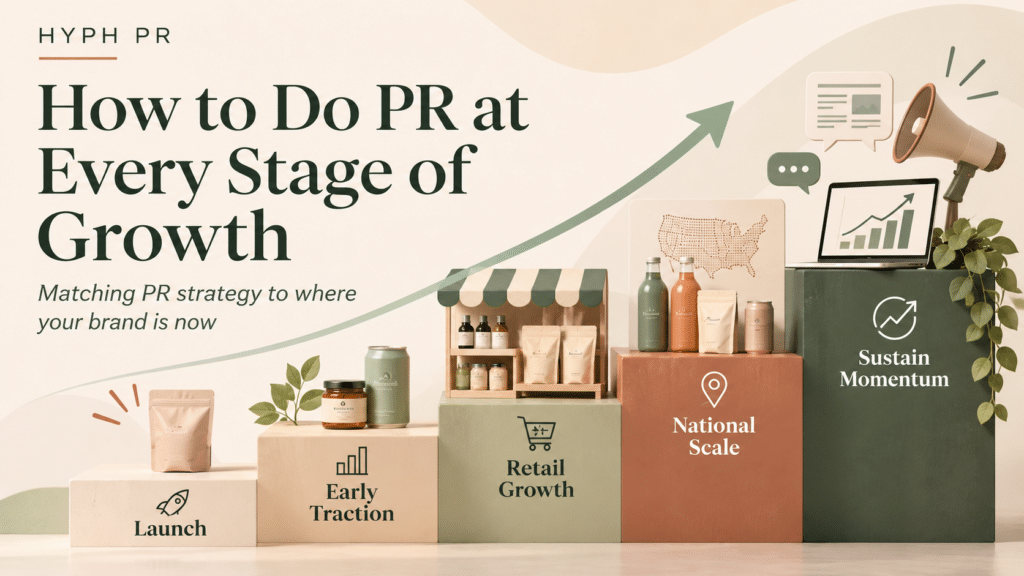
How to Do PR at Every Stage of Growth
By:
Sponsored by: HYPH PR is a full-service PR agency helping food & beverage brands grow through earned media, influencer seeding, and affiliate marketing that actually converts. They specialize in PR for the underdog crafting stories that get emerging brands the attention they deserve. Get 50% off your first month of PR services (with a 12-month agreement).
PR should not look the same for every CPG brand.
A brand that just launched does not need the same strategy as a brand entering national retail. A founder-led startup does not need the same media approach as an established brand expanding into new categories.
The mistake many brands make is treating PR like a one-size-fits-all service.
They think the goal is always national press, big media logos, or viral attention. But the best PR strategy depends on where the brand is in its growth journey.
At each stage, PR should support the business goal in front of the brand.
Stage 1: Launching the Brand
At launch, the biggest job of PR is to explain the brand clearly.
Who is it for?
What problem does it solve?
Why does it exist?
What makes it different?
Early-stage brands do not always need massive national press right away. They need a strong foundation. That means clear messaging, a compelling founder story, strong product descriptions, professional images, and a simple way for media, customers, and buyers to understand the brand.
At this stage, PR may focus on founder introductions, local media, niche publications, product seeding, early reviews, and category education.
The goal is credibility.
Before a brand can become widely known, it needs to become easy to understand.
Stage 2: Building Early Traction
Once a brand has early sales, customer feedback, and some proof of demand, PR can become more targeted.
This is when brands can start connecting their story to larger trends.
For example, a beverage brand may connect to functional ingredients, alcohol alternatives, hydration, or lower-sugar lifestyles. A snack brand may connect to school lunches, clean-label eating, protein, convenience, or better-for-you indulgence.
At this stage, PR should help the brand move from “new product” to “relevant category player.”
Media outreach may include product roundups, founder stories, gift guides, podcast interviews, affiliate opportunities, and trend commentary.
The goal is to show that the brand is not just available.
It is gaining momentum.
Stage 3: Preparing for Retail Growth
When a brand is preparing for retail expansion, PR needs to support sales.
Retail buyers want to know that customers care. They want to see demand, awareness, credibility, and a clear reason the brand belongs on the shelf.
This is where press can become a useful sales asset.
Media coverage can be added to retail decks, buyer follow-ups, sell sheets, launch announcements, and distributor conversations. It can help show that the brand has relevance beyond its own marketing claims.
At this stage, PR should be connected to the retail calendar.
Is there a new retailer launch?
A regional expansion?
A seasonal moment?
A product innovation?
A founder story that supports the buyer pitch?
The goal is not just to get attention.
The goal is to help make the brand easier to believe in and easier to sell.
Stage 4: Scaling Nationally
As a CPG brand grows, PR becomes more about authority and consistency.
The brand may already have distribution, customers, and some media coverage. Now the challenge is staying visible, relevant, and differentiated in a crowded category.
At this stage, PR may focus on national media, affiliate commerce, executive visibility, larger trend stories, awards, events, celebrity seeding, influencer campaigns, and trade coverage.
The messaging also needs to mature.
The story can no longer be only, “We are new.” It may need to become, “We are leading this conversation,” “We are changing how consumers shop this category,” or “We are building a brand with staying power.”
The goal is category credibility.
A scaling brand needs repeated signals that it belongs in the market long term.
Stage 5: Sustaining Momentum
Even established brands need PR.
In fact, mature brands often need PR to keep the story fresh.
Once a brand is no longer new, it needs new reasons for people to pay attention. That could include product launches, founder thought leadership, partnerships, retail milestones, cultural moments, seasonal campaigns, celebrity connections, sustainability progress, or category insights.
At this stage, PR helps prevent the brand from becoming invisible.
It keeps the company part of relevant conversations and gives customers, retailers, and partners new reasons to engage.
The goal is sustained relevance.
Strong brands do not only launch well.
They keep giving the market something meaningful to talk about.
Match the Strategy to the Stage
The best PR strategy is not always the biggest one.
It is the one that fits the brand’s current stage of growth.
A launch-stage brand may need clarity and credibility.
A growing brand may need momentum.
A retail-ready brand may need sales support.
A national brand may need authority.
An established brand may need fresh relevance.
When PR is matched to the right stage, it becomes much more useful.
It helps the brand build the right kind of visibility at the right time.
How HYPH PR Supports Brands as They Grow
HYPH PR is a boutique PR agency that works with CPG, food and beverage, wellness, lifestyle, and celebrity brands. For brands at different stages of growth, HYPH PR can help shape the right story, identify timely media opportunities, support product and founder visibility, and connect PR efforts to broader goals like retail momentum, affiliate opportunities, influencer campaigns, and long-term brand credibility.
That matters because PR should grow with the brand.
The strategy that works at launch may not be the strategy that works at national scale.
PR Should Grow With the Brand
CPG brands do not need PR for the same reason at every stage.
Sometimes PR is about explaining the brand. Sometimes it is about building trust. Sometimes it is about supporting retail. Sometimes it is about staying relevant in a crowded category.
The key is knowing what the brand needs right now.
When PR is aligned with the stage of growth, it becomes more than visibility.
It becomes a tool for building momentum.
Interested in learning how HYPH PR could support your brand at its current stage of growth? Ask for an intro by clicking the button below.
Education Articles