
- Marketing, Operations, Sales
Build a Digital Brand Ambassador for Your Website Using AI
By:
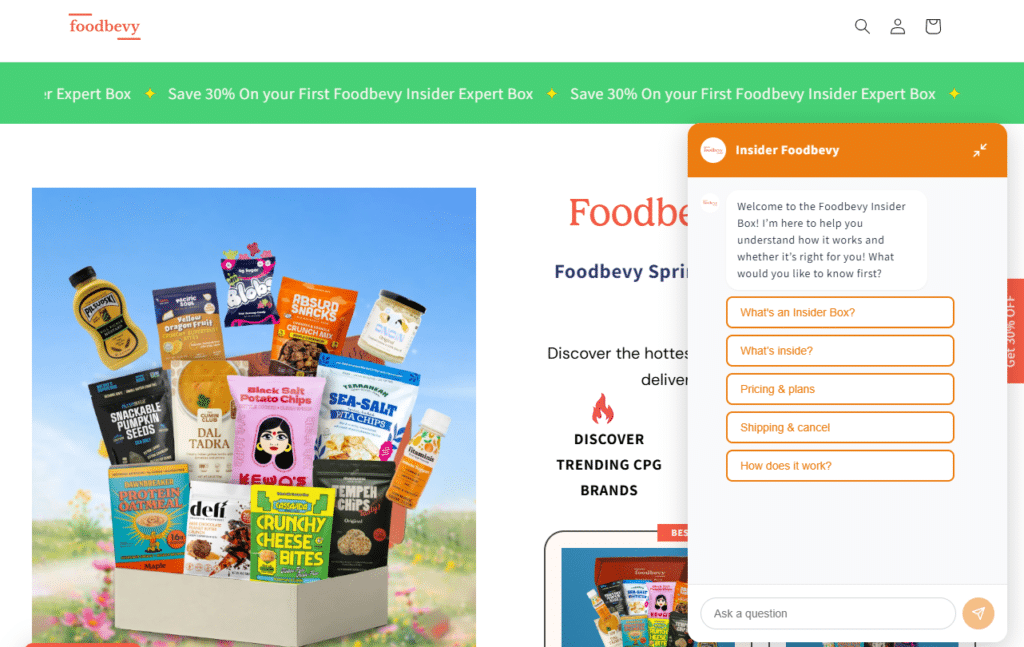
Sponsored by Capex PickUp, which is an AI chatbot trained on your website data to answer questions and drive customer engagement and purchase.
Is it possible to build a digital brand ambassador for your e-commerce store using AI?
Over the past year I’ve focused on building out the Foodbevy Insider Boxes and one thing I always wanted to do was “replicate” myself and make it easy to talk to every potential customer who came to the site. So this month I tested out a new AI chatbot called Capex PickUp.
The goal was two part:
- Educate website visitors about the Insider Boxes to help them make an informed decision with the goal of getting them to purchase.
- Identify obstacles preventing people from purchasing by analyzing what questions they have.
So how did it turn out?
As a disclaimer, Capex is a Foodbevy sponsor, but as part of this project I paid to use the PickUp chatbot.
How PickUp Works
PickUp is designed to act like a trained sales rep for your website. You upload your product information, FAQs, and brand knowledge, then guide how it should communicate through tone and response style. You can link it directly to your products so when someone asks a question, it doesn’t just answer. It guides them toward the right purchase.
In practice, that means you can train it on:
- Your product catalog and positioning
- Your subscription structure and pricing
- Your brand voice and tone
- Your FAQs and support scenarios
Once it’s set up, it sits on your site and handles conversations in real time. It uses AI that can handle any free-form questions a person may ask.
Data Overview: How the Chatbot Performed
We ran PickUp over a multi-week period to understand both volume and behavior.
Here’s how engagement progressed:
March 10–13: 175 site visitors, 19 chatbot sessions, 16 users, 3.7 messages per session
April 7–10: 56 site visitors, 46 sessions, 24 users, 2.9 messages per session
April 10–14: 33 sessions, 16 users, 2.5 messages per session
A few things stand out immediately.
More people started using the chatbot as a percentage of site visitors, which tells me the placement and timing made sense and visitors found it useful.
Message depth stayed consistent in the 2-4 message range. These were short, decision-focused conversations. Most users asked one or two questions, got clarity, and moved on.
We didn’t see purchases directly tied to chatbot sessions during this period, but this was also outside of our main quarterly launch window when demand is highest. That context matters when evaluating conversion impact.
What People Asked and What It Revealed
The questions were consistent across every time period.
The top categories:
- Pricing and plans
- What the Insider Box is
- What’s included
- Which option to choose
These questions sit squarely in the consideration and decision stages of the funnel. They show you exactly where friction exists.
Pricing questions tell you the offer is not immediately clear. We emphasize subscriptions, but we also offer a discounted first box. That creates a decision that needs to be explained more directly.
“What’s inside?” highlights the challenge of selling a curated product. Each box has up to 15 items. That’s a lot of value, but it also requires clearer presentation.
“Which plan should I choose?” points to positioning. Customers want direction. They don’t want to evaluate multiple options on their own.
We also saw lower-frequency but high-impact questions:
- What’s in the next box
- Spice level
- Shipping and cancellation
- Corporate inquiries
These are important. They represent specific buying concerns that can block a purchase. The spice level question stood out because it’s something I hadn’t considered including on the page. That’s a clear blindspot.
Final Take
PickUp did what I wanted. It answered questions and surfaced the exact questions customers have at the moment they are deciding whether to buy. That gave me direct insight into what needs to change on my site.
Based on this, the immediate actions are clear:
- Clarify how the subscription works and when you’re charged
- Improve how products are described and visualized
- Provide a preview or example of upcoming boxes
- Add details that reduce uncertainty, like flavor profiles or dietary context
Traffic was slower during this test window, so this wasn’t a clean conversion test. But the insights are actionable and directly tied to improving conversion.
If you want to improve your e-commerce site and understand what’s actually blocking customers from buying, PickUp gives you that visibility. And once you see those gaps clearly, you can fix them.
Want to try Capex PickUp yourself? Let me know and I’ll send over an introduction
Education Articles