
- Marketing
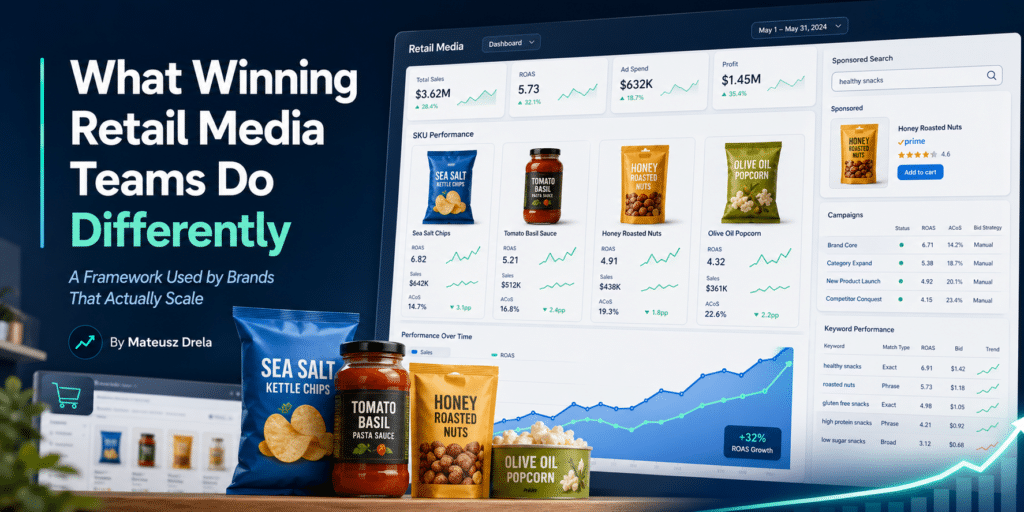
What Winning Retail Media Teams Do Differently
By:
Sponsored by RMIQ
Get discovered, sell more, and improve ROAS across Instacart, Walmart, and more — all in a risk-free, pay-for-performance set up.
On platforms like Instacart and Walmart, it’s common to see:
- 1 in 3 ad dollars generating zero sales
- Keywords priced with no connection to product margins
- Campaign-level ROAS that looks “fine”… while individual SKUs lose money
The issue is structure and not the effort.
Retail media performance happens at the SKU level, but most campaigns aren’t built that way.
Retail Media Has Changed the Game
In the past, shelf visibility was bought through budget and relationships.
Today? A two-person brand can outperform a billion-dollar competitor.
Retail media platforms don’t care about your size. They care about:
- Relevance
- Conversion rate
- Bid efficiency
That means the best-structured campaigns win.
And the upside is massive like on Instacart:
- Up to 90% of retail media sales come from new-to-brand customers
- 30–50% of those customers repeat purchase
Retail media is a customer acquisition engine.
Two Brands. One Framework.
Smash Kitchen: From Plateau to 6.7× Growth
A challenger brand with strong products but initially flat retail media performance.
What changes did Smasch Kitchen implement?
- Took full control of campaigns
- Shifted to SKU-level execution
- Eliminated “averaged” performance
Result:
- 6.7× QoQ Instacart growth
- 84% new-to-brand customers
Zack’s Mighty: Turning Ads into Growth Signals
What changed? They didn’t just optimize ads — they used retail media as a decision engine:
- Identified winning SKUs
- Shifted inventory and budget accordingly
- Doubled down on momentum
Result:
- 2× ROAS in under 2 months
- New product launch hit 8.5× ROAS
Why Most Retail Media Campaigns Underperform
Most brands rely on retailers native automated campaigns. Set it once and observe.
The problem? Platforms optimize for their ecosystem, not your profitability.
Common issues:
- 30%+ wasted spend
- Overbid or underbid keywords
- Strong SKUs subsidizing weak ones
Campaign-level reporting hides the truth. If your performance feels “fine but flat,” this is why.
The Radical Granularity Framework is key to maximizing retail media performance.
Step 1: Take Full Control
Full automation and set and forget set up is useful for data collection, not performance.
Winning teams:
- Run auto campaigns for 2–4 weeks
- Extract keyword data
- Then switch fully to manual control
Key principle:
You control keywords, bids, and budget — not the platform.
Step 2: Structure at the SKU Level
This is what most brands miss.
Grouping products = no real optimization.
Winning structure:
- One campaign (or ad group) per SKU
- SKU-specific keywords
- SKU-specific bids
- Independent performance tracking
If you can’t see SKU performance, you can’t scale profitably.
Step 3: Set Bids Using Product Economics
Stop using platform suggestions. Find out what is the maximum price you can pay per click and make sure your advertising is profitable.
Use this formula:
Max CPC = (Conversion Rate × Product Price) ÷ Target ROAS
Example:
- Price: $6.49
- Conversion rate: 37%
- Target ROAS: 5×
→ Max CPC = $0.48
Before Scaling Spend, Fix Conversion
Your product page directly impacts ROAS. Make sure it works for you and include:
- Clear, high-quality images
- Strong reviews – 5 makes a tonne of difference
- Visible benefits
- Certifications (organic, non-GMO, etc.)
Higher conversion = higher allowable bids.
Keyword Strategy
Start narrow:
- “Organic tortilla chips”
- “Gluten-free granola”
Then expand if you cannot hit target ROAS with narrow.
Process:
- Run auto campaigns
- Export keyword data
- Identify winners
- Move them to manual campaigns
- Scale in small batches
Small tests = faster learning.
Step 4: Weekly Optimization Discipline
Retail media is not “set and forget.”
Winning teams operate weekly:
- Adjust bids based on ROAS
- Scale winning keywords
- Cut underperformers
- Promote new search terms
- Reallocate budget across SKUs
This is where growth compounds.
The System That Drives Results
Step
Full control
SKU structure
Economic bidding
Weekly discipline
Outcome
Removes performance ceiling
Enables real optimization
Protects margin
Compounds growth
The Bottom Line
Retail media offers something rare:
- Equal competition with category giants
- Scalable customer acquisition
- High-intent discovery
But only if your campaigns are structured correctly.
Looking to maximize impact without the overhead?
That’s exactly what RMIQ was built for.
- AI-driven SKU-level optimization
- Full-funnel execution across networks
- Pay-for-performance (no retainers)
Education Articles