
- Distribution
How to Send Buyer E-mails that Get You on the Shelf
By:
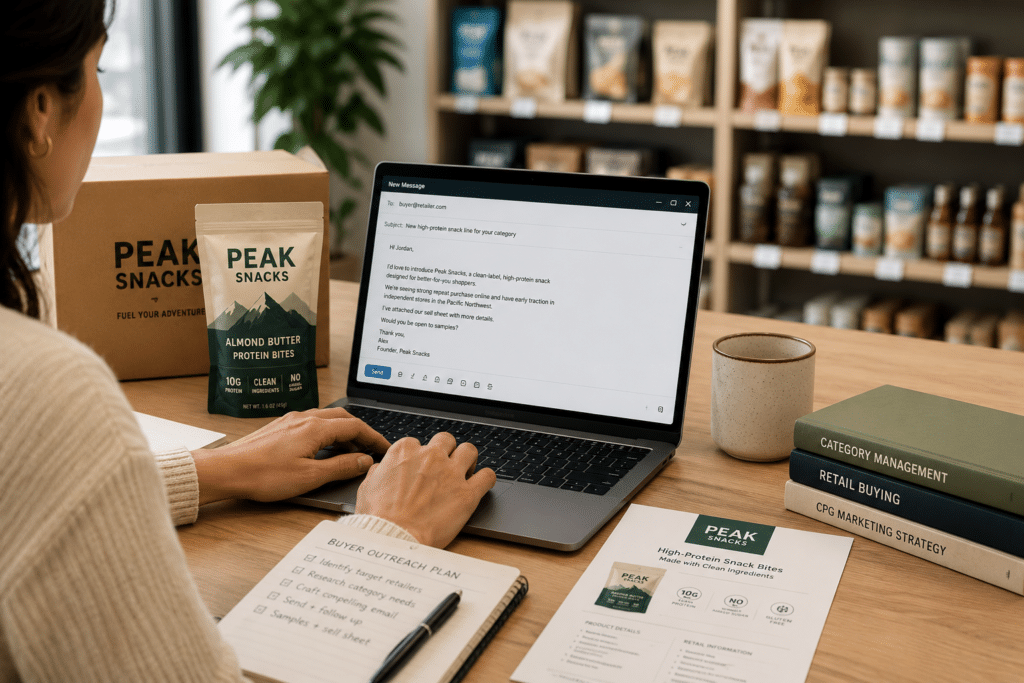
For CPG founders, getting on the shelf often starts long before a buyer meeting. It starts with an e-mail.
That first message may be the difference between being ignored, getting a polite “not right now,” or earning a closer look from a category manager. And while many founders spend months perfecting product formulation, packaging, pricing, and branding, buyer outreach is often treated as a quick task: write a short pitch, attach a sell sheet, and hope someone replies.
But buyers are busy. They review hundreds of products, manage category performance, track promotions, evaluate margins, and balance what shoppers want with what stores can realistically support. A strong buyer e-mail does not try to tell your entire brand story. It helps the buyer quickly understand why your product deserves consideration.
Here’s how CPG founders can write buyer e-mails that are clear, relevant, and more likely to move the conversation toward the shelf.
Start with the buyer’s reality, not your brand’s excitement
Founders are naturally passionate about their products. That passion matters, but it should not lead the e-mail.
Buyers are not only asking, “Is this a good product?” They are asking:
Will this fit my category?
Will it bring something new to the shelf?
Will shoppers understand it quickly?
Can this brand support velocity?
Are the margins, case pack, pricing, and distribution realistic?
Will this create operational friction for my team?
Your e-mail should answer those questions as efficiently as possible. Instead of opening with a long origin story, lead with the commercial reason your product belongs in their store.
For example, instead of:
“We started this brand because we believe snacks should be better for people and the planet.”
Try:
“We make a clean-label, high-protein snack designed for shoppers looking for convenient, better-for-you options in the afternoon snacking set.”
The second version still communicates the brand idea, but it does so in category language.
Write a subject line that earns the open
A buyer subject line should be specific, simple, and relevant. Avoid hype, vague claims, or anything that sounds like a mass pitch.
Strong subject lines often include the category, product type, retailer relevance, or a clear reason for outreach.
Examples:
“New functional beverage for your natural channel set”
“Plant-based snack line with strong regional traction”
“Clean-label pantry item for specialty grocery review”
“Retail-ready frozen entrée brand for category consideration”
The goal is not to be clever. The goal is to help the buyer immediately understand what the e-mail is about.
Keep the first e-mail short
Your first e-mail should not do everything. It should create enough interest for the buyer to reply, request samples, review your sell sheet, or schedule a meeting.
A good structure is:
Opening: One sentence explaining what the product is and why it fits.
Proof: One to three points that show traction, differentiation, or readiness.
Ask: A simple next step.
Attachment: Sell sheet or deck, only if useful and well-prepared.
A buyer does not need your full founding journey in the first message. They need a fast understanding of your product, your shelf fit, and your readiness.
Make the product easy to understand
CPG founders often use language that is meaningful internally but unclear externally. Phrases like “disruptive,” “innovative,” “premium,” “next-generation,” or “better-for-you” are only helpful when they are supported by specifics.
Instead of saying your product is “a game-changing wellness snack,” explain what it is:
“An oat-based snack bite with 10g of protein, no added sugar, and shelf-stable packaging.”
Instead of saying your beverage is “built for modern consumers,” say:
“A lightly carbonated functional beverage with electrolytes, positioned as a low-sugar alternative to traditional sports drinks.”
Buyers need to place your product mentally before they can place it physically. Help them see the shelf, the shopper, and the use case.
Include the facts buyers actually need
A compelling buyer e-mail should balance story with retail information. Depending on the stage of outreach, include the most relevant details, such as:
Product category and format
Key differentiators
Suggested retail price
Case pack
Wholesale pricing or margin structure, if appropriate
Distribution availability
Current retail placements, if any
Certifications or claims
Velocity or reorder data, if available
Promotional support
Shelf life
Sampling or demo support
Do not overload the e-mail with every detail. But do show that your brand understands retail basics. This signals professionalism and reduces the buyer’s concern that onboarding your product will be difficult.
Show traction, even if you are still early
Many emerging CPG brands worry that they do not have enough traction to impress a buyer. But traction can come in several forms.
If you are already in stores, mention relevant retail wins, reorder activity, or regional performance. If you are early, mention DTC demand, farmers market sell-through, foodservice interest, social proof, distributor conversations, or strong performance in independent accounts.
The key is to be honest and specific.
Weak: “Customers love our product.”
Stronger: “We’ve seen repeat purchasing through our DTC channel and have gained early placement in independent specialty stores in the Pacific Northwest.”
Weak: “We are growing fast.”
Stronger: “We launched in 20 independent accounts this year and are now preparing for regional chain expansion.”
Buyers do not expect every emerging brand to have national data. They do expect founders to know what proof points matter.
Personalize the e-mail without overdoing it
Personalization does not need to be long. A single relevant sentence is often enough.
For example:
“Given your focus on expanding better-for-you snacks, I thought this could be a fit for your upcoming category review.”
Or:
“We noticed your stores carry several premium pantry brands, and our line was developed for that same shopper.”
Avoid forced flattery. Buyers can tell when a message is copied, pasted, and lightly modified. The goal is to show that you understand the retailer’s format, shopper, and category needs.
Attach the right materials
A strong buyer e-mail is often supported by a strong sell sheet or concise brand deck. These materials should not simply look attractive. They should help the buyer evaluate the opportunity.
Your sell sheet should clearly show the product, case details, pricing basics, claims, shelf life, UPCs, contact information, and a simple reason to believe. Your brand deck can go deeper into consumer insights, founder story, product line architecture, retail strategy, promotional plans, and current traction.
This is one area where founders often benefit from outside perspective. Teams like GoodNow, which support CPG brands with retail strategy, buyer meetings, sell sheets, brand decks, and placement preparation, can help translate a founder’s story into the kind of materials retailers expect to see.
Make the ask simple
Do not end your e-mail with a vague line like, “Let me know what you think.”
Give the buyer an easy next step.
Examples:
“Would you be open to reviewing samples?”
“Can I send over pricing and a sell sheet for consideration?”
“Would this be worth a brief conversation before your next category review?”
“Who is the best contact for this category?”
The easier the ask, the easier it is for the buyer to respond.
Follow up without becoming noise
Many buyer conversations happen after the second or third touchpoint, not the first. Founders should follow up, but the follow-up should add value rather than repeat the same message.
A good follow-up might include a new retail win, updated sell sheet, upcoming trade show availability, distributor update, seasonal relevance, or a brief reminder tied to category timing.
For example:
“Following up in case this is relevant for your upcoming snack review. We’ve also added two new independent accounts since my last note and would be happy to send samples.”
Keep it short and professional. Persistence is useful. Pressure is not.
Avoid the most common buyer e-mail mistakes
Many founder e-mails fall short because they are too brand-centered, too long, or too vague. Watch for these common mistakes:
Leading with a long founder story before explaining the product
Making claims without proof
Sending attachments that are too large or poorly organized
Using generic language that could apply to any retailer
Failing to include retail basics
Asking for a meeting before giving the buyer enough reason to care
Following up too aggressively
A good buyer e-mail respects the buyer’s time. It gives them the right information in the right order.
Think beyond the e-mail
An e-mail can open the door, but getting on the shelf usually requires more than a strong pitch. Founders need to be prepared for item forms, distributor questions, pricing conversations, promotional expectations, samples, buyer meetings, and post-placement execution.
This is where many brands underestimate the process. A buyer reply is not the finish line. It is the beginning of a more detailed retail conversation.
Before you send outreach, make sure your brand is ready to answer:
What stores are the best fit?
What is your target channel strategy?
Can your operations support the account?
Are your pricing and margins retail-ready?
Do you have the right sales materials?
How will you support velocity after placement?
Founders who prepare for these questions before outreach are more likely to turn interest into actual shelf presence.
A better buyer e-mail template
Here is a simple framework CPG founders can adapt:
Hi [Buyer Name],
I’m reaching out to introduce [Brand Name], a [clear product description] designed for [target shopper/category need].
We believe it may be a fit for [Retailer Name] because [specific reason tied to the retailer, category, or shopper]. The line includes [brief product range], with [key differentiator such as clean-label ingredients, functional benefit, regional traction, certifications, or retail performance].
A few quick details:
Suggested retail price: [SRP]
Case pack: [Case pack]
Shelf life: [Shelf life]
Current traction: [Retail placements, DTC performance, distributor status, or early proof point]
I’ve attached a sell sheet for a quick overview. Would you be open to reviewing samples or pointing me to the best contact for category consideration?
Best,
[Name]
[Title]
[Brand]
[Phone]
[Website]
This template works because it is simple, buyer-focused, and easy to scan.
Final thoughts
The best buyer e-mails are not the loudest. They are the clearest.
For CPG founders, the goal is to show that your product is not only exciting, but retail-ready. Buyers need to understand what your product is, where it fits, why shoppers will care, and whether your brand can support the account after placement.
A thoughtful e-mail will not guarantee a spot on the shelf, but it can improve your odds of getting a serious look. And in a competitive category review, that first look matters.
For founders who want support refining outreach, preparing sell sheets, or navigating retail conversations, GoodNow works with emerging and established CPG brands on sales strategy, retailer meetings, placement preparation, and store outreach.
Interested founders can click the button below for an introduction.
Education Articles