

- Marketing, Sales
How To Optimize ROAS On Instacart
By:
A Step-by-Step Playbook for CPG Brands by RMIQ | AI-Driven Retail Media Performance Advertising for Lean Teams
Sponsored by RMIQ: Get discovered, sell more, improve ROAS, on Instacart and more. All in risk free pay-for-performance set up (no retainer).
Why Instacart Is a Media Platform, Not Just a Grocery App
Before touching a single campaign setting, it helps to understand what you’re actually working with. Instacart is the third-largest grocery retailer in the U.S., and it functions as an advertising medium with rules that are identical for every brand, from a two-person startup to a billion-dollar conglomerate.
The Scale You’re Working With
- 2,200+ national, regional, and local retail banners available for ad targeting
- Nearly 100,000 stores across all 50 states
- 600,000+ shoppers fulfilling orders
- Cloud Ads technology powering specialty retailers like Sprouts, Thrive Market, and Fresh Market
The Key Insight: Net-New Customers at Scale
Unlike Google or Amazon, where bidding on your own brand name often just cannibalizes existing sales, Instacart advertising is highly effective at capturing customers who are searching generically typing “tortilla chips” rather than your brand name. This is why up to 90% of sales from Instacart ads come from customers who have never bought your brand on the platform before.

What Good Performance Actually Looks Like
Here’s a benchmark from real brand data showing the difference between a basic automated setup and a properly optimized manual campaign:

The consistent pattern: automated campaigns tend to plateau around a 1.3–2.4x ROAS because the algorithm balances performance across all brands. Manual optimization breaks through that ceiling.
Choose the Right Ad Format
Instacart offers several ad formats (Reach, Engage, Acquire), but for the vast majority of CPG brands, one format should command 70–80% of your budget:
Sponsored Products (Your Primary Tool)
Sponsored Products, also called Sponsored Search is the only format that directly ties spend to measurable sales velocity. Ads appear across the entire consumer journey:
- Homepage and search results
- “Frequently bought with” sections
- Shopping cart placements
- Post-checkout screens

The Four-Step Optimization Framework
Automated campaigns waste 25–30% of budget on irrelevant keywords and are algorithmically capped and they cannot favor your brand over a competitor. Here’s how to build a structure that can.
Step 1: Switch to Manual Campaigns
Automated campaigns are designed to be “good enough” for the average user. If you’re reading this guide, you’re not the average user. You already know, achieving more is possible.
How to do it:
- Start with an Auto campaign for 2–4 weeks to harvest keyword data
- Export the keyword performance report
- Identify your top-performing search terms by ROAS and conversion rate
- Recreate those as Manual campaigns with specific bid controls

Step 2: One Ad Group Per Product (Radical Granularity)
This is the single highest-leverage structural change you can make. Grouping multiple SKUs together in one ad group prevents you from applying different bidding strategies to products that perform very differently.
The Problem with Grouped Products:
Say you have two SKUs, one with a 6x ROAS, one with a 3x ROAS. In a shared ad group, your bids are averaged across both. You’re overpaying for the weaker SKU and leaving money on the table for the stronger one.
The Fix:
- Create one ad group for each individual SKU
- This lets you set specific bids, budgets, and keyword lists per product
- Track performance at the product level so poor performers don’t drag down strong ones
Step 3: Build a Product-Keyword Matrix
Once you have individual ad groups per SKU, you need to set bids at the individual keyword level. Not all keywords perform equally and Instacart’s suggested bids are not calibrated to your ROAS goals.
Contextual Bidding in Practice:
- Bid higher on high-intent, high-conversion keywords (e.g., “tortilla chips” for a tortilla chip brand)
- Bid lower, but don’t eliminate adjacent keywords that still convert, just less efficiently (e.g., “crackers”)
- Ignore Instacart’s suggested bids in favor of bids derived from your own performance data
How to Calculate Your Max CPC:
Start with your target ROAS (e.g., 4.0x). Work backward to determine the maximum Cost-Per-Click you can afford while maintaining that target. Update bids weekly as performance data accumulates.

STEP 4: Weekly Mathematical Maintenance
Optimization is not a one-time event. Treat it as a weekly data review process.
Your Weekly Optimization Checklist:
- Export keyword-level performance data from the Instacart dashboard
- Identify keywords where ROAS has dropped below your target and lower those bids
- Identify keywords consistently beating your target and consider increasing bids to capture more volume
- Flag any new search terms surfacing in Auto campaigns that should be promoted to Manual
- Review spend allocation across SKUs and rebalance if needed
Operational Realities to Know
Retailer-Specific Campaigns
By default, your ads run across all retailers where your product is listed. There are two exceptions worth knowing:
- Specialty retailers like Sprouts and Thrive Market require separate accounts unless you’re using a unified third-party platform. Note: this is expected to change later this year
- If you have a SKU exclusive to one retailer, you can effectively target that retailer by running ads only for that SKU
Getting Your Products to Appear
If a product isn’t showing up on Instacart, the issue is usually upstream. National chains update their product data feeds weekly; regional and local retailers often update monthly. If a product is missing, confirm with your retail buyer that the SKU has been added to the specific data feed that retailer sends to Instacart.
Quick Reference: Do This, Not That
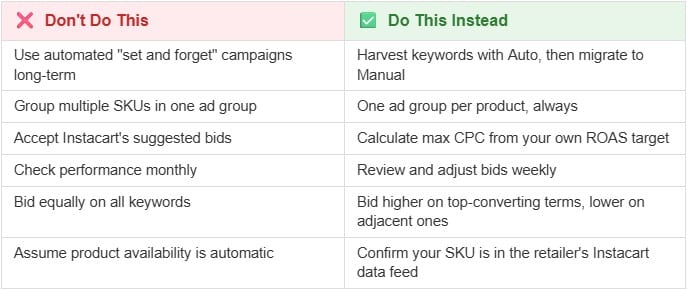
The bottom line:
Instacart rewards brands that treat it as a precision performance channel, not a passive listing service. The difference between a 1.3x and 4.9x ROAS isn’t luck, it’s campaign architecture, granularity, and weekly discipline.
If you’re a lean team, you may not have the capacity for that level of execution.
Then it’s time to partner with RMIQ | Retail Media Performance Advertising for Lean Teams to get discovered, sell more, and improve ROAS on Instacart and beyond. We provide AI-driven optimization of manual Instacart campaigns at the SKU-level, with end-to-end execution in a pay-for-performance model.
Education Articles